Showing posts with label science. Show all posts

Wednesday, January 13, 2016

Innovation and Science Promotion Foundation - Toys from trash

Children love toys. They are children’s best companion. All of us know that. But little do we recognize that toys teach them much better than textbooks. This is because children find toys curious and textbooks largely boring!


I can vouch for this from personal experience.

I once taught physics to an under-qualified eighth standard class in a school; they couldn't add two decimal numbers, despite the best efforts of their math teacher. I taught them to experiment an alternate teaching methodology using Arvind Gupta’s toys from trash . After a few demos, I challenged them to build toys from scratch, prepare explanatory charts and present it at an intra-class competition in 15 days. I though that would be challenging but achievable. To my surprise, all of them were ready for the competition in two days! I realized how much difference enthusiasm can make. In this case, a demo of 2 hours has brought out what 8 years of rote learning suppressed! Curiosity, creativity and enthusiasm.
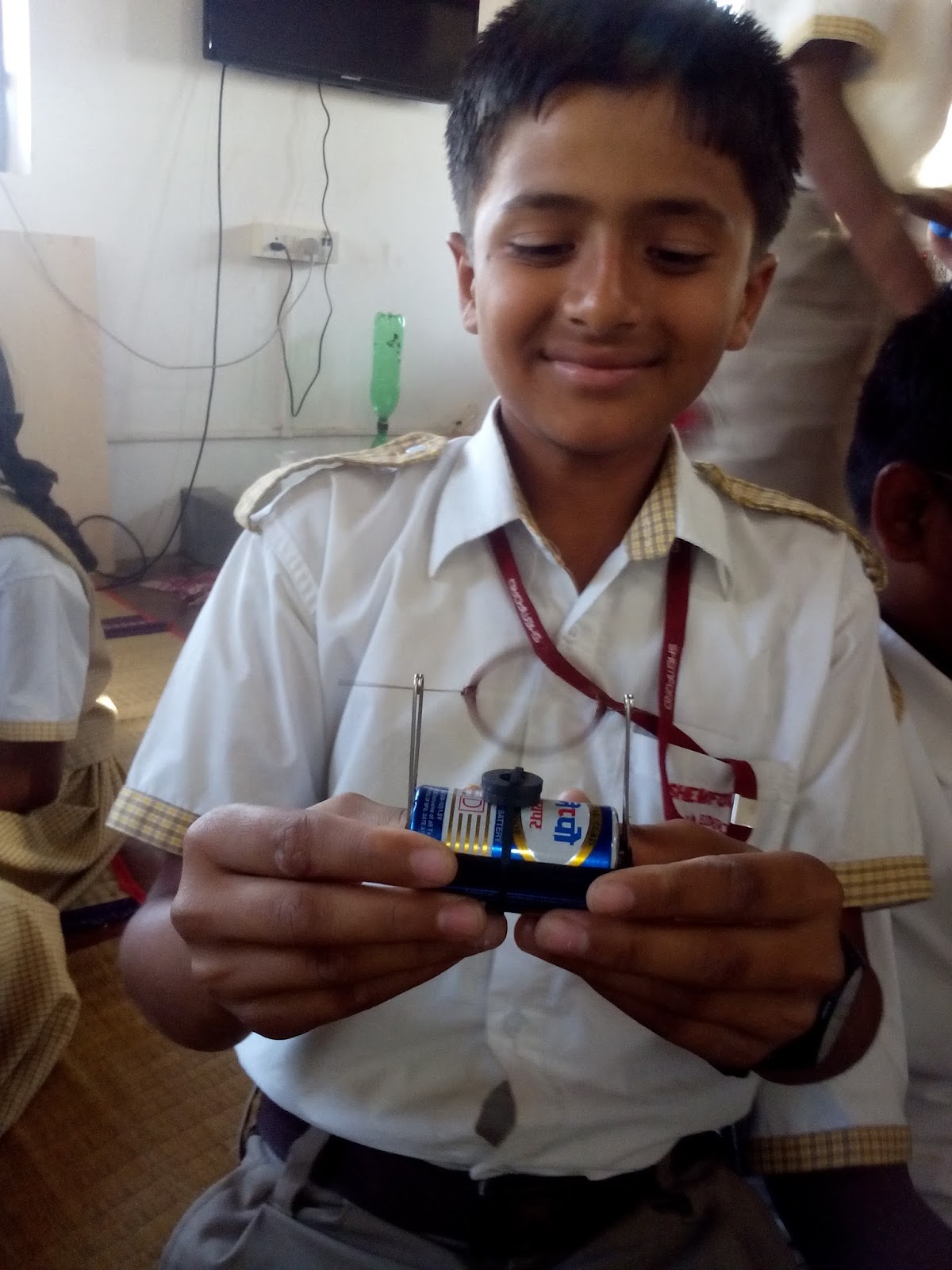
This kind of education should be mainstream! A little research quickly reveals that experts agree! Sir Ken Robinson, in his famous series of TED talks, said "Creativity should be treated with the same status as literacy". But in the current "industrial model" of education, "..children get educated out of it". Dr. Howard Gardner, famous for his theory on Multiple Intelligence, advocates (a) individuation -tailoring education to individual students - and (2) pluralisation - teaching an idea in different ways - to ensure that all children benefit from education.

Clearly, fostering curiosity, creativity and to revolutionize learning itself is the need of the hour. Innovation and Science Promotion Foundation (www.ispf.in) is working towards exactly that! Two people, Mr.Vishal Bhatt and Dr. Procheta Malik, with support from the founders have given up promising careers to design toys from trash, conduct workshops in schools and other public forums. During their workshop they work with children and encourage them to tinker with and explore the toys made out of trash.
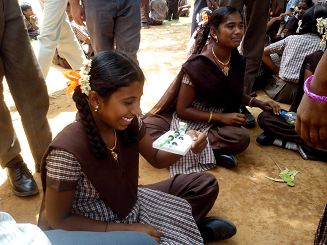

I visited their center in The Valley School, Bangalore. They have built over 200 toys (for example, DC motors, electricity generators from wind energy, 3D geometrical models) from items such as batteries, safety pins, cycle tubes, pencils, film-roll boxes and matchsticks. They spend their time in their center tinkering with the toys, coming up with improvements and variants that would help children learn their science without necessarily knowing that they are learning. Their work is inspiring! They owe their own inspiration to the pioneering work by Arvind Gupta, whose staff is primary among their advisers.

In their one year of existence, they have already achieved over 8000 interactions with children, each usually lasting around two hours. Sometimes they work with children for 15-20 hours over one week.

“Thanks to the conditioning around us, all of us come to believe that being scientific is the right of a selected subset of smart children. On the contrary, ISPF believes that humans are born scientific regardless of factors such as gender or family background. It's only a matter of sustaining the inherent interest and confidence to be curious, observant, experimentative and open minded.
Our experience says that toys are extremely engaging. In over 8000 interactions with children aged between 3 and 16 so far, we haven't met a single child was not engaged in the activity.”


Going forward , ISPF aims to create structured modules that can be integrated with the conventional school science and mathematics curriculum. Using these modules they propose to set up what they call "Rancho Llabs", where children will be encouraged to build, play, experiment, fail, learn and more importantly have fun with toys. The content itself is intended to be made available free of cost under the common license, but the real value would be to have the experience in the labs.

To this end, ISPF is open to tie-up with schools - private and public . They are also looking for funding from schools or any other institution. ISPF can be contacted by email (inispf@gmail.com). Their facebook page (https://www.facebook.com/scienceallaround) provides updated information on what they are up to.

Thursday, January 08, 2009

Taking the plunge

After taking a stab at various way of social intervention it seems that the way ahead seems to get slowly and clearer.

I have a school near my work that is looking for teachers.
I have my idea of doing the teaching with as much demonstration as possible.
I have the rickety infrastructure that the team at my office prepared once and gathering up dust.
I have a new set of 25 DVDs dedicated to physics demonstrations (thanks to the sincere belief in social and educational change of a few executive level managers of Synopsys!) that I have not yet started watching.

May be it is time to set aside an hour of my mornings to start teaching science. This is in a way going back to where it all started. The first of my thoughts on social change was to teach and teach at schools.

For now though, this thought has to remain as just another thought and the extent to which it fructifies over the next year hinges upon how much hit my conviction can take over the next couple of months! All the best to me!

Monday, December 15, 2008

Is targeting the poor alone always efficacious?

With my on and off involvement with centers close to social development, I find one attitude that may have to be changed for better efficacy of social initiatives. Let me have the first stab at defining the attitude.

"A social initiative will produce a better impact when it is targeted towards the economically poorer sections of the society. The richer the beneficiaries are, the lesser social impact it has.."

While in general this point has a validity, it has to be revisited for every specific case. Here is an example. A team of my friends and I conducted a science demo in a private school nearby. When I talked about this, "Don't you think your initiative would be more useful to students of government schools?" was one question that popped up universally. My answer is "In my case doing it in *this* private school is likely to have a higher social impact" . Why?

1. This private school doesn't have a lab infrastructure in spite of the students paying a nominal school fee (Rs. 200/- per month).

2. The students here do have a capability to read, listen to and understand English, Telugu and Hindi which provides us flexibility in our implementation. So, it gets easier for us to get more students to start "thinking and reasoning science" - a better success rate at our initiative. On the other hand, a government school on which we are working on the ability to grasp English is lesser providing us with challenges (lesser number of teachers from our office)

Much more importantly, access to better education sure is relatively much more difficult for the poor. However, schools that fall in the economic category of the one that we are working on also face problems faced by government schools (non-availability of teachers, labs etc.). In addition to that they also suffer the ignorance of NGOs that rush to help poor quality government schools. It is almost as if these students are paying Rs. 200/- per month to be ignored!

Thankfully, in our case, we need to ignite as many minds to think and reason (in science and others..). In our eyes, whether the students have the ability to pay Rs.200/- or not, if their inclination to reason is lacking, they are equally poor! Only the former is equipped with a skill (English language) that offers flexibility for us to make a better impact.

A society, apart from being categorized into economically richer and poorer, can also be categorized into rich and poor based on other criteria. And the economically richer need not be richer (or have better opportunity) in all the other categories. Social upliftment, one must remember, is not only the upliftment of the economically poorest, but the upliftment of the society as a whole.

Wednesday, July 02, 2008

Hitting the Road: Teaching module - Draft 1

Idea generated for schools so far
  • Teach kids to make their own notebooks.
How does this help?
    • non-availability of free notebooks @ govt schools
    • potential means to earn
  • Teach kids of appropriate age about technologies related to clean energy like solar energy
    • How tap solar energy
    • How the market is growing etc
How does this help?
    • creating experts in a market of demand for the future
  • All the soft-skills appreciated in a corporate environment
    • committing to a task of reasonable difficulty and completing it on time
    • being regular with work taken up and establishing proper communication about updates/possible delays
How does this help?
    • time-management, probably study better while being good at extra-curricular
    • develops proper attitude and work-ethics and improves job-prospects
  • Safety
    • Basic fire-safety
    • First-aid and emergency response
    • Details of phone numbers, addresses of hospitals in vicinity.
How does this help?
    • Duhh......!
  • Community activity
    • Some kind of an activity that sensitized them
  • Community activity
    • Some kind of an activity that sensitized them to importance of sanitation, public health, environment etc.

Hitting the Road:Teaching module - Draft 1

Idea generated for schools so far
  • Teach kids to make their own notebooks.
  • Teach kids to make chalk piece

How does this help?
    • non-availability of free notebooks @ govt schools
    • Relevant vocational training
    • potential means to earn
  • Teach kids of appropriate age about technologies related to clean energy like solar energy
    • How tap solar energy
    • How the market is growing etc
How does this help?
    • creating experts in a market of demand for the future
  • All the soft-skills appreciated in a corporate environment
    • committing to a task of reasonable difficulty and completing it on time
    • being regular with work taken up and establishing proper communication about updates/possible delays
How does this help?
    • time-management, probably study better while being good at extra-curricular
    • develops proper attitude and work-ethics and improves job-prospects
  • Safety
    • Basic fire-safety
    • First-aid and emergency response
    • Details of phone numbers, addresses of hospitals in vicinity.
How does this help?
    • Duhh......!
  • Community activity
    • Some kind of an activity that sensitized them
  • Community activity
    • Some kind of an activity that sensitized them to importance of sanitation, public health, environment etc.

Friday, June 20, 2008

The Wonders of Physics

Remember those days at school? Understanding how things work was an option as against a necessity. To put it correctly, it was relegated to being an option because of another necessity. Scoring! I remember my teacher standing under the blackboard and actually telling us "If yo u don't understand, Memorize!". That clearly defined the priority for us. To make things worse, we had a live example in the rank-holder. Irrespective of his/her understanding of the subject, he/she universally memorizes. Besides, we are left at the mercy of diagrams in science books that leave much to our ability to imagine, and the lab experiments that don't relate to what we study in the classroom to understand. In many ways, understanding was not even an option. Further still, which other subject apart from, may be, mathematics had any content to be understood?

English, Tamil: A bunch of poems to be memorized. For prose, the answers to the questions were always a couple of paragraphs..and some grammar to be remembered. Done!
Social studies: Memorize! Its a collection of stories, dates and names anyway.
Science was cat-on-the-wall. Some you understand, some you don't. But never mind. Go the social studies way!

Such an attitude bothered me even as a kid though I didn't know what to do to understand other than read the book again. Honestly, I really didn't think about how "understanding" is really going to help me in the future! I never had a future beyond the upcoming exam then! :) Looking back, the worst feeling I have is, I didn't even realize that science can actually be understood deeply.

Now, after reaching a stage when all those years of "darkness" won't matter anymore, (not to mention the lamenting so far...) it is still gratifying to know that someone is working to bring science in its natural form right to the people who needed it the most. Kids!

"The Wonders of Physics" is a series of demonstrations on various concepts of classical physics like light, sound, pressure, heat. The credit for this initiative goes to Professor Clint Sprott of The University of Wisconsin-Madisson. The videos taped during his demonstrations buffers for free online! You don't really need to have a kid who is struggling with understanding science to watch these videos! You can wash your sins that you were forced to commit in your school days even now. Its never too late! :)