Showing posts with label education. Show all posts

Wednesday, January 13, 2016

Innovation and Science Promotion Foundation - Toys from trash

Children love toys. They are children’s best companion. All of us know that. But little do we recognize that toys teach them much better than textbooks. This is because children find toys curious and textbooks largely boring!


I can vouch for this from personal experience.

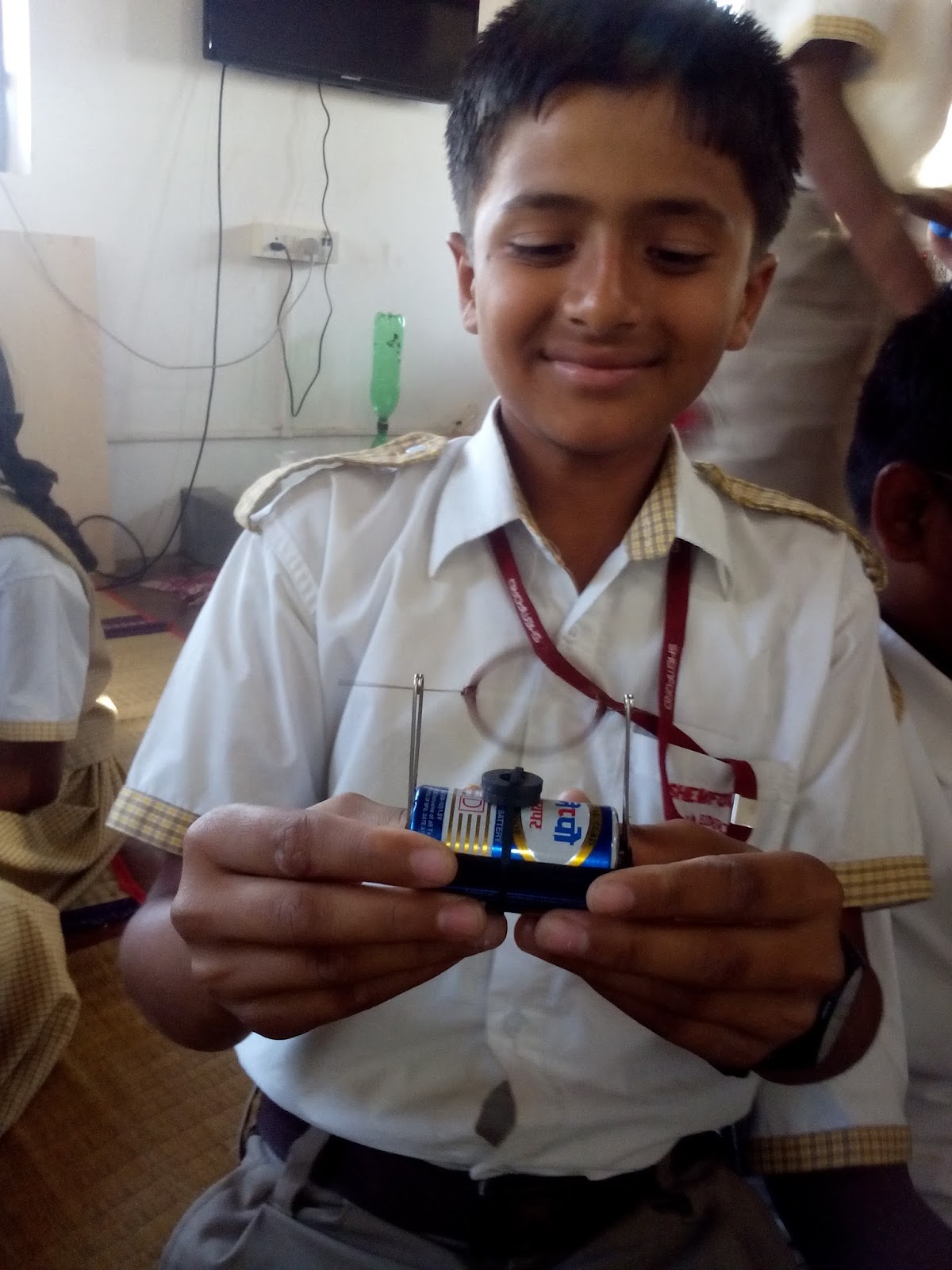
I once taught physics to an under-qualified eighth standard class in a school; they couldn't add two decimal numbers, despite the best efforts of their math teacher. I taught them to experiment an alternate teaching methodology using Arvind Gupta’s toys from trash . After a few demos, I challenged them to build toys from scratch, prepare explanatory charts and present it at an intra-class competition in 15 days. I though that would be challenging but achievable. To my surprise, all of them were ready for the competition in two days! I realized how much difference enthusiasm can make. In this case, a demo of 2 hours has brought out what 8 years of rote learning suppressed! Curiosity, creativity and enthusiasm.
This kind of education should be mainstream! A little research quickly reveals that experts agree! Sir Ken Robinson, in his famous series of TED talks, said "Creativity should be treated with the same status as literacy". But in the current "industrial model" of education, "..children get educated out of it". Dr. Howard Gardner, famous for his theory on Multiple Intelligence, advocates (a) individuation -tailoring education to individual students - and (2) pluralisation - teaching an idea in different ways - to ensure that all children benefit from education.

Clearly, fostering curiosity, creativity and to revolutionize learning itself is the need of the hour. Innovation and Science Promotion Foundation (www.ispf.in) is working towards exactly that! Two people, Mr.Vishal Bhatt and Dr. Procheta Malik, with support from the founders have given up promising careers to design toys from trash, conduct workshops in schools and other public forums. During their workshop they work with children and encourage them to tinker with and explore the toys made out of trash.
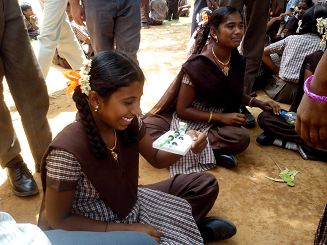

I visited their center in The Valley School, Bangalore. They have built over 200 toys (for example, DC motors, electricity generators from wind energy, 3D geometrical models) from items such as batteries, safety pins, cycle tubes, pencils, film-roll boxes and matchsticks. They spend their time in their center tinkering with the toys, coming up with improvements and variants that would help children learn their science without necessarily knowing that they are learning. Their work is inspiring! They owe their own inspiration to the pioneering work by Arvind Gupta, whose staff is primary among their advisers.

In their one year of existence, they have already achieved over 8000 interactions with children, each usually lasting around two hours. Sometimes they work with children for 15-20 hours over one week.

“Thanks to the conditioning around us, all of us come to believe that being scientific is the right of a selected subset of smart children. On the contrary, ISPF believes that humans are born scientific regardless of factors such as gender or family background. It's only a matter of sustaining the inherent interest and confidence to be curious, observant, experimentative and open minded.
Our experience says that toys are extremely engaging. In over 8000 interactions with children aged between 3 and 16 so far, we haven't met a single child was not engaged in the activity.”


Going forward , ISPF aims to create structured modules that can be integrated with the conventional school science and mathematics curriculum. Using these modules they propose to set up what they call "Rancho Llabs", where children will be encouraged to build, play, experiment, fail, learn and more importantly have fun with toys. The content itself is intended to be made available free of cost under the common license, but the real value would be to have the experience in the labs.

To this end, ISPF is open to tie-up with schools - private and public . They are also looking for funding from schools or any other institution. ISPF can be contacted by email (inispf@gmail.com). Their facebook page (https://www.facebook.com/scienceallaround) provides updated information on what they are up to.

Sunday, September 13, 2015

Education: A few thoughts and one radical idea


Lets think about education at school and its current status in India.

  • Our government schools are undesirable to us citizens. We send our children to government schools if we can't afford private schools, or if we are  government employees.
  • Our public education depends on budget allocation and hence driven by economy. 
  • Though there are improvements in public education (RTE, play-way methods and achievement of universal enrollment) quality remains sub-standard, it would be fair to say that it hasn't evolved fast enough to match the need.
  • Our private schools range from cheap to expensive ones. In general they prepare students to be the workforce for India's private and public enterprises. They prepare them for work, but not for life. 
  • Private schools are business enterprises and it’s a sellers' market. Schools dictate the price of the commodity,  they assess the quality of the raw material (read children) before being used as an input, and tailor the finished product (read students finishing 12th grade or equivalent) to meet a standard (read college entrance exams!). If it mandates, they have the free hand to get rid of the raw material midway, if they feel that not doing so would significantly diminish the perceived reputation of the business (school).
  • School expenses form a significant percentage of family expenditure regardless of whether  the school is a cheap or an expensive one.

I am no expert in education, even though I am interested enough to read, watch and discuss a lot about constantly. I think the above summary fairly captures the reality about today's education in India. Needless to say, this has to change. But how should education be?

Stakeholders should recognize  that employability does not completely define success in education. It is only one dimension of success. What defines complete success of education is, in itself, is a worthy matter of debate, research and stakeholders are better of forming a framework for this. However, in my opinion, when a child turns sixteen, if she recognizes
  • her interests, has a general idea of how to pursue it,
  • that an unfamiliar situation makes her curious rather than insecure
  • how to handle a setback and use it as a lesson
  • that excellence can be attained through resilient pursuit, constant endeavor to improve rather than "high adrenaline, last minute" preparation
  • that mental, physical health as important as professional success
  • that social responsibility is relevant

the school would have played its part. Clearly, only academic excellence as the primary aim doesn't do justice to this end. If children right across the different strata of the society are to be empowered, the school system should be highly research-oriented, personalized, universal (inclusive of children with economic and learning disadvantages) and evolving.

To make it research-oriented and personalized, teaching position should be made reputed enough to attract in the best minds. Such individuals should be empowered by the stakeholders (government, parents, school administration) to design or modify the curriculum.

To make it universal, education should be decoupled from yearly budget allocations or reduction and the uncertainties of market economics. Education should be cheap if not free.

To make education an evolution, exams should be considered as much an assessment of teaching quality as it is of learning ability.

Countries and local governments best known for their education system already implement the above suggestion. Finland, considered to have the best education system in the world, offers free education with highly personalized curriculum designed and customized by empowered teachers. USA, despite a lot of criticism of its educational policies, has a lot of best minds like Howard Gardner, Carol Dweck and multitudes of school teachers and teacher-trainers devising, customizing and implementing teaching methodologies at all school levels.  A look at Edutopia would give an idea about the mind-boggling churn around education. I don't see this level of energy at the school level in any of the stakeholders here in India, though we do have positive outliers like Maduram schools, Barefoot college, Government Primary School in Motwada and Azim Premji University.

Following the footsteps of those who have tasted success is a good start, but devising our own strategy  in education is just as important to ensure quality. I would like to put forth one radical idea here - as a question rather than a suggestion. To my knowledge this isn't done in any other country.

Given that education has to be universal, economically insulated from the market uncertainties and unprejudiced, is there a good case for making education as the fourth branch of democracy alongside legislature, executive and judiciary? After all, judiciary is largely not affected by the prejudice of the government, judges and judicial staff do get paid even though they don't add any value to the market (nobody asks where the money comes from!) and education of our children play as important a role in the future of our society  as does justice. Doesn't it?

Thursday, July 16, 2015

A chance to learn Storytelling!

As a student at school, how good a teacher taught directly affected whether I understood and hence whether I loved a particular topic of discussion or not. With a little experience at teaching under my belt, I hold an opinion that a good teacher is so significantly because she is a good storyteller.

As a father I try to surround my daughter with books and puppets to keep her engaged in stories told by humans and books instead of TVs and mobile phones. With limited success I must add, but that is a subject matter of a different post.

Chennai and Bangalore citizens have an opportunity to be better storytellers this August and September. Kathai Kalatta is organizing a Storytelling Festival titled, "Under The Aaladamaraam".
I hope that this would be a great experience for interested parents, teachers and creators!

Here are details of the event at Bangalore and Chennai. See you there! Have fun!


Wednesday, May 04, 2011

Is education all about innovating gibberish to remember things?

I visited a local NGO run school during a corporate CSR activity. The NGO was well run as the school they have set up offers not only the mainstream education, but also the vocational stream. I "co-facilitated" a session on "How to ace an interview". It was gratifying as the presentation was at the right time, when students graduated and got ready for the interview.

We had a free interaction session with the school kids before closing the day when one kid asked "How do we make studying simple?". I jumped at the possibility of conducting a science demo. Before I realized, a colleague said "You should imagine what you study! it makes studying easier". He gave an example. He said, "By remembering a simple phrase, "MaGoMahendra", I used to be able to answer any kind of questions, be it fill-up, multiple-choice etc. What does this gibberish mean? "Ma" stands for Mahanadi, "Go" stands for Godavari and Mahendra is the mountain range that stands between the two rivers! Voila!

I thought "Where is the imagination part in this? Look at what we teach them? Is education all about innovating gibberish to remember things?" But the students looked amused. He sensed the attention he got and started off on a continuous rambling that lasted about 30 seconds. Nobody could figure out what he was saying. After a moment's pause and suggestive smile he said, "It is the phrase I coined to remember the entire periodic table". I heart sank. But the shock was yet to come. To my utter disbelief, the teacher started to clap loudly and the rest of the gathering joined! Now I feel, a science demo will either sell big, or it will fall flat!

Thursday, July 02, 2009

Deemed universities demystified!


Have you ever wondered how so many deemed universities have mushroomed, that too out of colleges with no reputation? The latest copy of Frontline provides answers and outlines how it all started with a politically motivated move by Murli Manohar Joshi that soon opened a can of worms.

Friday, June 26, 2009

Reaction to new education bill


Optional 10th exam is a bad move. The schools will internally assess poorly performing students allowing them to pass on to ensure better pass percentage.

Monday, December 15, 2008

Is targeting the poor alone always efficacious?

With my on and off involvement with centers close to social development, I find one attitude that may have to be changed for better efficacy of social initiatives. Let me have the first stab at defining the attitude.

"A social initiative will produce a better impact when it is targeted towards the economically poorer sections of the society. The richer the beneficiaries are, the lesser social impact it has.."

While in general this point has a validity, it has to be revisited for every specific case. Here is an example. A team of my friends and I conducted a science demo in a private school nearby. When I talked about this, "Don't you think your initiative would be more useful to students of government schools?" was one question that popped up universally. My answer is "In my case doing it in *this* private school is likely to have a higher social impact" . Why?

1. This private school doesn't have a lab infrastructure in spite of the students paying a nominal school fee (Rs. 200/- per month).

2. The students here do have a capability to read, listen to and understand English, Telugu and Hindi which provides us flexibility in our implementation. So, it gets easier for us to get more students to start "thinking and reasoning science" - a better success rate at our initiative. On the other hand, a government school on which we are working on the ability to grasp English is lesser providing us with challenges (lesser number of teachers from our office)

Much more importantly, access to better education sure is relatively much more difficult for the poor. However, schools that fall in the economic category of the one that we are working on also face problems faced by government schools (non-availability of teachers, labs etc.). In addition to that they also suffer the ignorance of NGOs that rush to help poor quality government schools. It is almost as if these students are paying Rs. 200/- per month to be ignored!

Thankfully, in our case, we need to ignite as many minds to think and reason (in science and others..). In our eyes, whether the students have the ability to pay Rs.200/- or not, if their inclination to reason is lacking, they are equally poor! Only the former is equipped with a skill (English language) that offers flexibility for us to make a better impact.

A society, apart from being categorized into economically richer and poorer, can also be categorized into rich and poor based on other criteria. And the economically richer need not be richer (or have better opportunity) in all the other categories. Social upliftment, one must remember, is not only the upliftment of the economically poorest, but the upliftment of the society as a whole.

Wednesday, November 19, 2008

Face-to-Face with Comat technologies

Cross-posted from ThinkChange-India

TC-I Fundwatch has recently reported a Rs. 60-crore investment by Omidyar Network and Unitus Equity Fund (UEF) on Comat technologies, a profitable social enterprise doing business with the rural poor.

The CEO of Comat technologies Sriram Raghavan recently talked to NASSCOM Emerge Blog and offered some good insights into Comat's success in becoming a profitable social business.

Sriram's answer to one question explains the business model of Comat technologies succinctly.

"Q. Your own business is built around the Rural Business Centres. What exactly are these?

SR: It is a very simple concept. The rural business centre is primarily an access point for rural citizens, where we use technology to deliver different kinds of services - only those that help improve the quality of life in villages. We don’t want to sell soaps and consumer goods.

I’ll give you two examples. Take government certificates such as birth, death, land and property related papers. If you have to get one from the taluk or the district office, you have to go to that particular office, wait in a long line and follow cumbersome processes. We deliver it to the village directly – it takes about five minutes for the same cost, i.e., Rs. 15 per certificate. This makes a very big difference to the rural consumer.

The other area we are in is education. There are teachers in rural areas, but the quality of education is very poor. Our centres bring live classes from best teachers in cities who broadcast their lessons online, much like the erstwhile UGC programmes. Except that here, we have two- way interaction and the students and teachers can speak to each other."

Sriram Raghavan also shared a few of his experiences with rural consumers that can come handy to a new social enterprise venturing into the villages.

"In a typical agrarian set up, income generation is a twice-a-year cycle – unlike in urban areas where we earn monthly salaries. It is important to bear this in mind as you have to position your product around this insight."

With a turnover of Rs.55 crore while improving the lives of about 10 million rural inhabitants, there should be little doubt about the success of this unique business model. But the best aspect about the venture is that it has identified one critical handicap of the Indian villages and working successfully towards eliminating it. Better said by the man himself.

"All these years, rural India has been isolated; they have been “informationally disabled”. It is now time for a change and we want to ensure that."

SE session 10: Writing fund-raising proposal

I couldn't attend this class. So, this post owes its credit to my classmate, Manmohan Jain.

1. Most NGOs overseas average about 51% earned income. The percentage for Indian NGOs is much lower. Earned income is income generated by the NGO. It could be either by
- sales of goods (T-shirts, auction of paintings by hearing-impaired children)
- volunteer activities e.g organizing a qawali nite / music concert
- beneficiary created products (hand made carpets or some other handicraft of a particular community)
2. People give to People -
At the end of the day it is a person that you are making the appeal to. It may be a foundation that makes grants, or a government body or a corporate that you are seeking funds from, but eventually the pitch is made to a person - for e.g a trustee or board member.
Similarly when making their decision they are considering you, your credibility etc. You may have a great cause, your NPO may have good track record, but still it does matter in terms who is the person appealing to them.
A fraction of funds raised may be impersonal but any large grants - the "people to people" principle applies.
3. Understand donor - what appeals to them, what is important to them, what is their process for selection.
4. Pareto principle - how 80 % efforts might only give 20% returns and often it is core 20% activities that give most of the Return Of Investments so focus on those.
5. Acronym for sources of income - GGCIE (you can refer to the slide on this)
6. Fund raising cycle - PDCA Plan -> Do -> Check -> Act
Or on similar lines
Need -> Sources -> Method -> Select / Evaluate
with the last step feeding back into the first in each case. For example, you evaluate you results and re assess/replan your needs.
A good question to answer is "How will you sustain the work after the grant runs out?"

Plan: Research sources - who will you target? Refer to GGCIE. If it is Government what schemes and programmes are available?
V K Puri's "Government funding schemes for NGOs/NPOs in India" lists several hundred schemes and can be very useful resource.
7. We went over SSA proposal format and some of the sections in that.

If applying to Companies and CSR departments, they will certainly need metrics/measures

8. A good exercise in planning phase is to project the need over time and match to appropriate sources. For example
- quick or short term needs - selling T-shirts, individual volunteer donations of small amounts
- long term needs - grants from foundations/governments. This will have long lead time and typically be larger amounts.

9. Objectives of CSR:
- branding
- employee motivation and feel good factor
- shared objective e.g KidSmart ?
- good business
- social responsibility
Went through exercise in actual writing of funding proposal. The template used is in slides 10 to 14 The class broke up into 4 groups of 2 each and spent about 30 mins preparing a proposal and then presented to rest of class.

Each was critiqued by Prof Bhargava, pointing out what was good and what needed improvement.
Some key points
- be specific in your title if you can
- have facts, clear breakdown of expenses/projected needs
- shows you have done your homework
- have measures or impact - short term/long term, even can mention associated/corollary impact
e.g rehabilitation of street children addicted to drugs will reduce crime in the locality - in 1 year impact can be seen

After the exercise we saw short video where a trustee/grant making body official talked about how they decide and how it is never a cut and dry Yes/NO answer.
- donors would want to review and evaluate
- they would want to visit and assess
- they are assessing the individual /invidividuals making the application, what is their credibility, integrity, commitment etc
- the decision takes time and combines several factors
So it is not black and white - yes/no.
Caution: Never put any fact or any statistic that is not real or cannot be substantiated

We then saw a real proposal example . Hindi Martin Institute and went over its salient points. It was a real life actual proposal that got funding.
Finally he touched briefly on results versus indicators and the LFA - problem solving technique. (I need to learn more about this).

Saturday, October 11, 2008

SE-session 9: Project Management

I would like to start off at the last! My take home of the day! (more of a suggestion than a rule of thumb though)
Identify what your beneficiaries need, sensitize the beneficiaries about their need and your solution, involve the beneficiaries of the social initiative to participate and if possible manage the initiative.

Project planning should be approached from a mixture of top-down and a bottom-up approach. Top-down, as in using "from the book" ideas like management and leadership principles, business models etc. Bottom-up as in getting to know what the beneficiaries (or end users) want and forming strategy based on that.

The class started off with some basics about project management. It is not only a science, as it involves rational thinking, data analysis and decision-making, but also an art since it involves getting the job done using your wits.

We moved on to a brief analysis of the difference between a program and a project.

Program: Long-term or on-going activity, continually funded and has regular allocation of budget. Example: National literacy mission

Project: Usually short-term, one-time funding. Usually a program is made up of a lot of projects that achieve the purpose of a program

Following this, we discussed a questionnaire, answering which one may have planned an entire project well considering all aspects and would be ready to hit the road. This took us all the way up to the break and formed a very important learning session of the class (so, don't skip the link!)

During the second half of the session, the instructor presented the way his initiatives in eliminating rural poverty made an impact in the livelihood of the rural society. He devised and designed various initiatives for the benefit of rural poor in various sectors like agriculture, education, micro-finance, health, income generation.

He talked about the federated model of self-help group (summarized by slide-3 of the PDF doc) in Andhra Pradesh, which was a run-away hit in the whole of the country. The success of the model was summarized by the fact that about 42% of all the money allocated by the Indian government is used by AP, while the repayment rate is 98%, unmatched by any other SHG anywhere else. Delegates from other states and even countries like Vietnam visit AP to study the SHG model.

Since this post is not about singing the praise of AP's SHG models, I move beyond to aspects that are common to all the government projects (including SHGs) that he was involved.
  • All project involved formation of Village organizations (VOs) which essentially is a representative body of the village. They were legally registered as co-operatives. All SHGs and VO are composed of women from the village
  • The relevant govt. representatives train and sensitize them about the need of the co-operative. (If it is agriculture.. training is on retaining profit and eliminating middle-men during procurement... if it is micro-finance, training is on how important savings is etc..)
  • Once training is done, the initiative is implemented and the outcomes are measured!
The model of sensitizing and involving the beneficiaries in various levels from management to volunteering has largely produced good results (will be evident from the slides of the session that I will post once they are available to me). But few do fail to scale up after initial success.

The whole session was finally summarized by the discussion titled "Why do projects succeed?"
highlighting the points user involvement as a participant, continuous funding, Clear understanding of goals, effective planning and setting realistic expectations of scope, quality and time involved.

By the then, we were about half-an-hour past time and we didn't even realized it. (I was especially mesmerized by the facts and figures he presented by the success stories of SERP's rural development initiatives). But he left us with a mention that goals should be SMART

Specific: Well-defined and clear to project managers
Measurable in terms of qualitative parameters
Agreed upon by all stakeholders
Realistic, as in set within the availability of resources
Time-based

Brief Profile of Mr B. Ravi Shankar

Mr. B. Ravi Shankar has completed Post Graduate Diploma in Computer Applications and also in Management (Rural development) from Xavier’s Institute, Ranchi.

Earlier he worked as a project officer in the Society for Rural Industrialization, Ranchi, Jharkhand, as a Community Coordinator in Girijan Cooperative Corporation, AP, and as a Project Director of Leather Industries Development Corporation of AP. He also has the experience of working in IT sector for sometime. Presently he is the Project Manager of Society for Elimination of Rural Poverty (SERP), (IKP-VELUGU project), AP.

Saturday, September 20, 2008

SE-Session-6: Field visit to NGO Bhumi

In this session, we made a field visit to Government High School at the heart of Rasoolpura, known as the largest slum in Hyderabad (some say in AP). This school was adopted by Bhumi, an NGO that aims at large scale, holistic, sustainable transformation for the slum (and for the larger society in a long term).

Bhumi's members Sai and Pallavi (one of CSIMs students too!) greeted us and gave an outline of their flagship Dhronacharya and Ekalavya program (DNE) in which Bhumi trains and deploys volunteers to mentor the school children on a weekly basis on academics and extra-curricular activities. The program seems to spring from the notion that kids in the slum study better when they are exposed to an "elder-brother-cum-role model" who can inspire and provide them a regular learning environment.

Abdul Mujib Khan, one of the founding members of Bhumi, provided a brief account of their history. Rasoolpura, like any other urban slum, faced multiple interlinked problems. Poverty resulting in child labour, in turn resulting in low academic performance and high dropouts. Poor conditions resulting in poor health problems, in turn resulting in loss of wage which compounds the problem of child labour and education. Further, the cynicism of the slum dwellers towards the "outsiders in Proline T-shirts" posed another layer challenge.

To address the first problem, Bhumi has divided its task in Rasoolpura into four domains viz., Livelihood, Education, Healthcare and Water & Sanitation. Then it adopted the then dilapidated Govt. High school. and with funding from Sarva Shikhsa Abhiyan and Hyderabad Round table, they renovated the school, hired teachers and got the school back up and running. This automatically helped Bhumi address the second problem too as the promise kept acted as a good testimony to their commitment to area. With more kids in school on a regular basis, the DNE program was launched in an effort to improve the pass percentage (then a dismal 13%) among 10th std kids. To improve the livelihood, Bhumi used the trust built to constitute about 6 self-help groups among the womenfolk (headed by a slum-dweller named Razia).

A crucial aspect that needs addressing in improving this society, they said, is the mentality slum-dwellers towards the SHG in general and using the loaned money in particular. As expected, the primary modes of income to people in the slum are fruit and vegetable hawking, house-help, working as a driver or running an autorickshaw. Since the livelihood is always hand-to-mouth, the mentality to save and planning for the longer term was lacking and took repeated counselling to attain a decent awareness level present now. Further, when Razia tried to spread the idea of forming a "group" the first question they usually asked was "How much money will I get?".

Bhumi is also involved in improving the other dimensions of the problem that affects education. Health. One school of thought suggests that children brought up with inadequate nutrition till the age of 5 show learning disabilities that affect them for the rest of their life. They took the initiative to bring in some students of medicine to conduct "Bailey's test" and found that about 20% of them fail the test. However, since medical treatment needs to be sustained over a long term for improvement, it is challenging to keep the respective families interested.

With the slum-dwellers increasingly placing their trust on them, Bhumi is also working on slowly training and transfering the control of their initiatives to the local slum-dwellers, though this seems to be a long objective.

A few other takeaways from the field visit

Their initiatives, especially with respect to education, are modeled in such a way that it can be "sold" to the government to adopt as an accepted model of education (am a bit confused about this, asked for clarification, will update!)

Bhumi seems to have extensively used the help of CSIM, who I have found myself are larger directory of contacts than "YellowPages" if you are a social entrepreneur. They have also helped Bhumi is redesigning their DNE mentoring program.

Most of their successful initiatives have been field tested on a smaller scale (say, applied to a smalller section of the slum) and then have been scaled up. Probably a good point to remember.


Overall, Bhumi provides quite a few lessons to learn the easier way. The biggest lesson of it all is probably the way they have conquered the trust of the slum-dwellers by delivering on the promise of renovating and bringing the school alive, which seems to have had an immediate effect on families the students hail from and those who live in the adjoining areas.

Saturday, August 30, 2008

SE-session 3: Innovations in social sector

Agenda:
Innovation:
1. Another perspective
2. Social sector
3. Examples
4. In class innovation
5. Prescription

The class began with the emphasis that Individuals can make a difference.
Before the discussion of the items on the agenda, we had a short discussion on plastics and its environmental impact in which professor Bhargava indicated (at least my perception) that recycling is not will not avoid or reduce environmental impact of non-recyclable materials.

1. Innovation: Another perspective

Answered the question "What is innovation?"

Discussed a scenario that forced innovation.

Scenario: A hotel with malfunctioning air-conditioner and an ineffective fan. The room is infested with mosquitoes. There is a 60-watt bulb. There is a mosquito mat, but no matches or any other source of fire. How to use the mat to find a solution to the mosquito-problem that lasts till morning.

Solution: One can use the 60-watt bulb as a source of heat. But it is too hot to be used directly and the mat won't last till morning. So, a one-rupee coin can be balanced on the bulb with the mosquito mat placed on top.

My inference: Innovation is a practical solution to solve a problem at hand using available resources, that need not be meant to address the problem at hand.

Innovation also the need to emphasize lateral-thinking. As an example of lateral-thinking we saw videos of ads by Coca-cola and Pepsi

2. Social Sector - Triple bottom-line
Social sector shares a lot of similarities with for-profit sectors. A list is as under
  1. Hierarchy
  2. Objective
  3. Resource management
  4. Quality
  5. Ethics
  6. Customer (beneficiary) satisfaction
  7. Marketing
However, there is one difference. For-profit organizations have a single objective of making profits, while a social enterprise should have a tripple bottom-line of People Planet and Profit

3. Examples of innovation in Social sector:
Few examples in different categories of social sectors were discussed

Co-operative:
Amul, a mik co-operative, that mobilized individual milk-men to form a co-operative to find a way to get more returns. Karsan bhai also started a CSR initiative, by which the members of Amul invest a small portion of their earnings towards building health infrastructure.

Rural Employment
Poverty alleviation

Grameen Bank's Micro loans initiative for the poorest

Attrition reduction
The instructor didn't name the company based in Bangalore, but highlighted the innovation for tackling the attrition problem. They identified that attrition becomes a problem only when timely replacements are not available. The company studied the background of those who leave the company and found that a majority is from Bihar. So, they targeted the exiting employees from Bihar and asked them to get one person from his village and train him/her thus taking care not only timely replacement but also overlapping the training time.

Others:
Big shoe bazaar
Shoes of size 11 or above don't sell much, hence aren't stocked by many of the showrooms. Bigshoebazaar.com connects the demand for big shoes to the supply (tie-ups will all the shoe companies) for which the latter provide a discount. This provides a winning situation for companies (big shoes are sold more), and customers (they find the shoe of their size with much less hassle!) while earning money out of it (a share in the discount!)

National Innovations Foundation: A compendium of rural innovations

4. In-class innovation
The instructor divided us into groups of two and asked us to identify a social problem, propose an innovative solution and identify the tangible benefits of the solution.

One group identified the lack of teaching talent in government school. To combat that problem, they proposed a teacher's training institute close to the locality of the school, channelize students who have completed 10th stds to the institute. That was voted the most innovative and effective idea of all the proposed ideas (for which the team got a large bar of chocolate).

5. Prescriptions
As a prescription for innovation in social sector, the instructor highlighted the importance of
  • community involvement and promote self-reliance (exit strategy for the NGOs after providing solutions)...
While NGOs can provide a solution to problems, they
can't stay forever to maintain the solution, and that the beneficiaries
need to take ownership of the solutions.
Being associated with Byrraju Foundation, he pointed efforts taken by the foundation in this direction
  • Innovation for a purpose, than for the sake of innovation
He showed a  funny cartoon in which a student shows his work to a bewildered teacher. The quote runs like this. "My name was David, but the name is old-fashioned, so I shortened by name as DVD!"

So what is the take away from this session?  

When you hit upon an idea, do some research to find if anyone has hit upon the same idea and has gone a certain disatance. It gives an opportunity to learn the easier way and introduces a potential partner.

Be open to borrowing best-practices from the for-profit sector. For-profit is not necessarily against non-profit. Just the purpose is different. So there is a lot of scope for common interest.
Note about the Instructor:


Prof.Harsh Bhargava,

Harsh is an Engineering graduate from BITS, Pilani and M Tech from IIT, Kanpur besides MMS from Osmania University. For over three decades he was involved in institution building, outsourcing management and indigenous design, development and implementation of embedded real time systems in various capacities in Indian Navy. Widely traveled, Harsh is a keen environmentalist who gives his time for social causes. He has edited 7 books in the areas of Business Process Outsourcing, Rural Transformation, NGOs and Virtual Leadership.

Harsh is currently a Professor at The ICFAI Business School, Hyderabad and has also served with Byrraju Foundation.

Wednesday, August 06, 2008

Profile - Amy Smith, MIT D-labs

Ms. Amy Smith is an instructor MIT's D-Lab which offers courses in Mechanical Engineering. But unlike the conventional engineering course or lab, Ms. Smith along with Ms. Bishwapriya Sanyal offer a course in which engineering students don't just learn the concepts of mechanical engineering, but go all the way to complete a product that addresses need of the under served communities of different parts of the world.

In a four-part course, the students start out ( in the "Design" part)learning about specific sectors of development that need to be addressed and the appropriate technology that can be applied. The second ("Development") part, is a combination of
  • lecture, which talks about various aspects of design like affordability, sustainability, design for manufacture and assembly,
  • Labs that offer experience on fundamentals like welding, circuit-boad design, CAD etc
  • Case studies and field trips to understand the needs of the people to who this product will eventually be useful
  • design review discussions to present and refine ideas of the product
The third ("Dissemination") part of the course focuses on brain-storming ideas to make the product that conceived by part-two to be "ready to roll", which includes making the product scalable, affordable and marketable. The fourth part executes what was conceived in part three.

In the process, her team has been successful in providing local solutions for local yet, problems local to a specific region as against trying to find a generic "one-size-fits-all" solution. The best example for this is offered by the following video of her presentation outlining a method of using sugarcane waste and biomass to produce a clean and efficient fuel thus providing a solution to the worst killer of children under five - household cooking smoke, but also to make the fuel at home using the abundant agricultural waste (this avoids cutting trees and cuts down on expenses in buying fuel) Truely amazing...and this is just one of the projects in MIT D-labs.


Monday, August 04, 2008

Laptop for school kids

A recent post in ThinkChange India made me squander much of my work time into this post. But what the hell!

When the news comes out, it sure does come out in bulk! :) This is not the only laptop for education story I came across within the last week. Here is Classmate from Intel and ICT's research initiative on a computer for Rs. 400. This sure seems to be another emerging trend that will change the future forever. But is it for good or for the worse? Here is my take.

Positives:
1. The three laptop initiatives put together, laptop should reach the bottom of the pyramid faster. I have my doubts about XO and classmate, but if ICT's initiative is a success, Rs.400 laptop should be affordable to anyone who is rich enough to afford school books.

2. "meant for education", probably means that it allows parents worried about the darker side of the internet such as adult content to breathe easy.

3. About "expensive laptops vs. reading, writing", I think reading and writing wouldn't suffer a loss that can't be compensated by improved creativity, skill and understanding that current book-oriented education suffers from.

Negatives:
The idea of bringing technology right into classroom sounds amazing, but I wonder if this initiative is taken because of a clearly identified necessity in the academia that such laptops can address (looking at it from the govt's perspective rather than OLPC or ADAG). It is one thing to use a laptop for an academic purpose and it is another to modify the academia for using a laptop! Currently, I don't see any resource that talks about this. So, while I don't see this as a definite negative, I doubt if the state cares enough to architect an educational model that includes the laptop to serve its purpose rather than model itself for using the laptop.

Another concern is, cheaper laptops is likely to translate into more laptops, quicker obsolescence and more wastes...and that with already bad waste management system and a proven slow and reactive (as against proactive) government, the future of waste management doesn't look too good. But, this may be the catalyst that pushes the govt. to do something about wastes.

On the whole, I find that the negatives such a improving the curriculum, waste management are a few things that have to be done regardless of the"laptop for education", but a computer with the purpose of making education entertaining, creative and productive would be a big leap forward at best and a small leap forward at its worst. So, Go laptop!

Monday, July 28, 2008

Mr. Role model IAS

The offshoot of the fast growing economy and getting-rich-fast middle class is not only the fast increasing consumerism, but also fast increasing social consciousness among the young-and-the-restless. Consequently, the government apathy and corruption seems to dominate the hot debate, be it in the media or overtea.

But are all those in the government corrupt? Or all of them callous towards their duty? Over the last few month I have come across some surprising encounters that demonstrated extra ordinary commitment public interest amongst a few bureaucrats (IAS officers) who, in their flesh and blood, walk the surface of India (this is a partial lift-off from Einstein's famous mention about Bapuji).

Here is quick mention of three of them

Mr. M.N. Vijaykumar, IAS (Bangalore, Karnataka)

He has been a crusader against corruption among his colleagues and politicians in the state of Karnataka for the past 25 years. He had once tried to introduce a transparent systems by which files related to public works are freely available online at http://bngregcommr.freespaces.com/ (link broken), but three days before the site became operational, he got transferred with immediate effect. That was just one of the six-times he was transferred for either blowing the whistle or trying to make the system more transparent. His wife maintains a frequently updated blog in which she claims harrassment and threats by his own higher-ups and attempts on his life. She also has a forum for people to participate.


Dr. Santhosh Babu, IAS (Krishnagiri, Tamil Nadu)
He has made news for his success in bringing school kids to where they belong - school!. In his back2school program he partners with Sarva Shikha Abiyan and AID India, uses computer technology to track kids who don't show up for school, and send a Village Volunteer force (VVF) track them down, find out the reason (usually the necessity to work), solve their respective problems and bring the kids back to school.

To show the scale and effectiveness of this program, let me provide two quotes from Business Standard here
"The effort involves a 10,000-Village Volunteer Force (VVF) consisting of child volunteers, panchayat presidents and headmasters of the 1,700-odd schools in the district."
"Using software aptly named, back2school, developed by Chennai-based Arbiter, the district administration monitors each schoolgoing child daily. And the results are showing: 8,000 of the 8,867 school dropouts are back in school."
And this is just one of the slew of his educational initiatives such as Ariviyal Anandam (Joy of science) program provides science kits and trains teachers to use them to teach children in about 10 districts of Krishnagiri, and Padippum Inikkum ("Education is interesting too") initiative to use trained volunteers of AID India and SSA help teachers and students to improve the reading ability of the kids by way personal attention and in-class demonstration.

Dr. Kushal Pathak, IAS India Post
A medical doctor by education and an avid web-developer by hobby he has harnessed his passion and profession to create not just one, but two useful platforms for the general public who may need help on social issues and issues related to handling the government.

bighelpers.org is a forum of citizens to help his/her fellow citizens on any problems he/she may face, from drinking problem, getting a ration card or filing a police complaint.

He has also created another web-portal dedicated to Right to information in which he has comprehensive information database and discussion forum for procedural and legal aspects exclusive RTI.

India has a lot of people and limited available resources. This leads to competition and inevitably forces people to bend or break the rules for survival. Given that, it is easy for anyone (not just a government official) with a secure job to step down from his/her ideological stance and settle for an easier way of earning his/her life (by way of corruption or simply shunning responsibility). In this scenario, the live example provided by these three extraordinary gentlemen (and I am sure a numerous others unknown to the general public) upholds the faith that good governance and justice do have place outside the
law books and among the society. It is just a matter of will.

Full credits to where it is due.

Thursday, July 03, 2008

Bridging gap between academia and industry - One step closer?

I remember the days from undergraduate college when I would attend the computer lab session once a week, sit in front of a dying black-and-white computer monitor with nothing but MS-DOS and copying FORTRAN program from the "observation notebook".

I also remember that right after college, I used to go to TULEC - A TATA Infotech computer education center which charged Rs.40000/- for its software courses.

Looking back I can't but wonder if the courses that were offered to me in TULEC should ideally be part of my college curriculum. After all, all the software companies needed the skill and the century or so old University of Madras still had syllabus that was also probably as old and badly needed upgradation anyway. Couldn't the former push the latter for its own good? It seems the stakeholders, the companies and the government have finally turned that corner. FINALLY!

Addressing the Fifth annual NASSCOM HR Summit 2008 in Chennai (July 3-4), Dr. Chandramouli, IT Secretary of Tamil Nadu said that 'IT finishing schools' that "would act as a pre-employment training centre to hone the skills of both engineering and non-engineering students to make them readily employable" [The Hindu - July 4] would start functioning within a month's time. In this is public-private partnership training center would be up and running in all the districts of Tamil Nadu. Each centre would have about 25 computers and students will go through a 3-month training program designed and conducted by the participating companies.

An ICT Academy of Tamil Nadu (ICTACT) is also setup for training the faculty, apparently to allow the cutting-edge industry knowledge to percolate into classrooms directly.

Prima facie, the stakeholders (mainly the government) are serious about this initiative, given that the ICTACT is autonomous, with board of directors represented by the state government, academic and industry (it would be good to know who they are) and a research and training headquarters would be set up in Chennai.[ Business Standard - July 4]

But the scary part is, a search on ICTACT in Google or Tamil Nadu's IT department website comes up with nothing. I guess one has to wait just a little longer to see the bridge across the abyss that separates the academia and the industry, but hopefully only a little longer.

Wednesday, July 02, 2008

Hitting the Road: Teaching module - Draft 1

Idea generated for schools so far
  • Teach kids to make their own notebooks.
How does this help?
    • non-availability of free notebooks @ govt schools
    • potential means to earn
  • Teach kids of appropriate age about technologies related to clean energy like solar energy
    • How tap solar energy
    • How the market is growing etc
How does this help?
    • creating experts in a market of demand for the future
  • All the soft-skills appreciated in a corporate environment
    • committing to a task of reasonable difficulty and completing it on time
    • being regular with work taken up and establishing proper communication about updates/possible delays
How does this help?
    • time-management, probably study better while being good at extra-curricular
    • develops proper attitude and work-ethics and improves job-prospects
  • Safety
    • Basic fire-safety
    • First-aid and emergency response
    • Details of phone numbers, addresses of hospitals in vicinity.
How does this help?
    • Duhh......!
  • Community activity
    • Some kind of an activity that sensitized them
  • Community activity
    • Some kind of an activity that sensitized them to importance of sanitation, public health, environment etc.

Hitting the Road:Teaching module - Draft 1

Idea generated for schools so far
  • Teach kids to make their own notebooks.
  • Teach kids to make chalk piece

How does this help?
    • non-availability of free notebooks @ govt schools
    • Relevant vocational training
    • potential means to earn
  • Teach kids of appropriate age about technologies related to clean energy like solar energy
    • How tap solar energy
    • How the market is growing etc
How does this help?
    • creating experts in a market of demand for the future
  • All the soft-skills appreciated in a corporate environment
    • committing to a task of reasonable difficulty and completing it on time
    • being regular with work taken up and establishing proper communication about updates/possible delays
How does this help?
    • time-management, probably study better while being good at extra-curricular
    • develops proper attitude and work-ethics and improves job-prospects
  • Safety
    • Basic fire-safety
    • First-aid and emergency response
    • Details of phone numbers, addresses of hospitals in vicinity.
How does this help?
    • Duhh......!
  • Community activity
    • Some kind of an activity that sensitized them
  • Community activity
    • Some kind of an activity that sensitized them to importance of sanitation, public health, environment etc.

Thursday, June 26, 2008

Access to notebooks at govenment schools

I was in conversation with an active member of India Sudar, an NGO working on the education for students from the lower-economic section of the society.

I came to know from him that while the government provides textbooks and uniforms for free, they don't have the capability provide notebooks. This unsurprisingly turns out to be a severe limitation to learning. When inquired, the government officials respond,
"Even the government has limited resources. To offset our limitations we have empowered the school's headmasters and senior teachers to partner local NGOs and philanthropists to receive the relevant aid".
Makes sense doesn't it? But I think, and the India Sudar member agrees, that this is not a sustainable model. So, what do we have? Even when ills like hunger and child-labor are removed from poor kids' way to the school, the good work is undone by the absence of guaranteed access to something as trivial as notebooks. I think this is a good idea for social entrepreneurship. Notebooks are available everywhere. Can be made from recycled paper too! Making notebooks is a good small-scale business. All it needs is an entrepreneurial idea that takes care of the economics and connects the demand and supply. Are you aware of any already existing models? (not donation of notebooks of course). Do you have any idea yourself?